This is one reason I heavily push for roof top solar, even if it is a bit more expensive than utility scale. In many areas air conditioning is pretty much a given at this point.
A typical solar panel absorbs ~20% of the sun's energy blasted on to a city rooftop. If that's used to power air conditioning it's doubly effective. You're reducing the heat urban heat island effect from the sun's energy, and you're also not adding additional heat from external power sources in to the city.
On a large scale this would really help make cities more livable. On a hot summer day here in northern Kentucky I noticed a massive difference (I've roughly measured it at a 5-7F difference) going from less developed areas to the more urban areas.
With regards to temperature, there are more levers to pull, like the aspect ratio of the street (narrower = cooler). Architects in Taiwan and southern China have been studying arcaded streets (qilou/騎樓), which seem to be as good as trees for shielding pedestrians [1], except in situations where the sun might shine through the sides or ends.
Of course, trees are great for many other reasons like air quality, but for temperature fundamentally they're just big evaporative coolers. I wish cities in more water-stressed areas would consider arcades + rooftop solar.
The big advantage trees have ove most man-made shade is that heat can convect through them. If you’ve ever sat underneath an umbrella at a café versus a beer garden under trees you’ll notice the difference. The umbrella shades, but traps reflected heat, re-radiating it below.
Trees also provide a significant cooling effect by releasing water vapour into the air from the soil (evapotranspiration), which you won't get under an umbrella.
Qilou seem much more oriented around shelter from the rain than for shelter from the sun, though. I agree that they're a great addition to urban streets for pedestrians!
Leaves block the Sun relatively high off the ground, meaning people are in the shade during the hottest part of the day and feeling as much radiation off buildings and streets in the evening.
Beyond cooling they’re also good for water management. Most street trees don’t need any watering (at least in the Midwest) they live off rainwater. When it rains, water pools on the leaves and evaporates from there, reducing the amount of run off and keeping the street drier and less humid on days with light rain.
In cooler months (and places where this is relevant) the leaves fall and you can still get the warming benefit of sunlight.
I love trees and want more of them in our cities, my only point is that they are not usually a substitute for HVAC unless your climate is in a precise sweet spot of plentiful water, dry air, and not too much heat. Rather than letting wishful thinking snowball into bad policy and disappointment, let's promote trees by focusing on what they do well (what you've mentioned plus aesthetics and sound damping) rather than by ignoring the limitations of evaporative cooling.
In which climate zones do trees not make their surroundings more temperate? Trees live from Alaska to the equator, and from the coast to near-desert. They are not de-humidifiers, but they certainly regulate temperature.
They reduce the load. I live in a place with hot humid summers. My block is shaded with mature oak, nut and maple trees. There’s always a breeze, and less solar energy is absorbed by blacktop.
I guess we disagree on what trees do well. I’m in the Midwest with warm semi humid summers. Trees keep the area around them massively cooler, not by evaporation but by shading.
Maybe it’s a disagreement of terms? I guess they aren’t technically “cooling” the area in an active sense, but they absolutely keep it cooler even when it’s 95 and the dew points over 70
I live in Vietnam. It is 8am right now and the dew point is 80. It only 80 at the moment but is supposed to get up to 90 later in the day. I assume the dew point will also go up to around 90.
AccuWeather says the "RealFeel" will be 97 and "RealFeel Shade" will also be 97, so being in the shade does almost nothing, since it is overcast and raining very slightly at the moment.
We're not in a heat wave or anything, this is just normal weather basically year round. If anything it's been especially rainy and cool the past few weeks.
Trees are nice but are not remotely a substitute for air conditioning. Trees do not lower humidity enough to stop the average European/American from sweating constantly just sitting still here.
Vietnam is sub-tropical, not directly comparable. Better to compare Vietnam to itself, with and without trees. How much hotter is it in the city compared to the jungle?
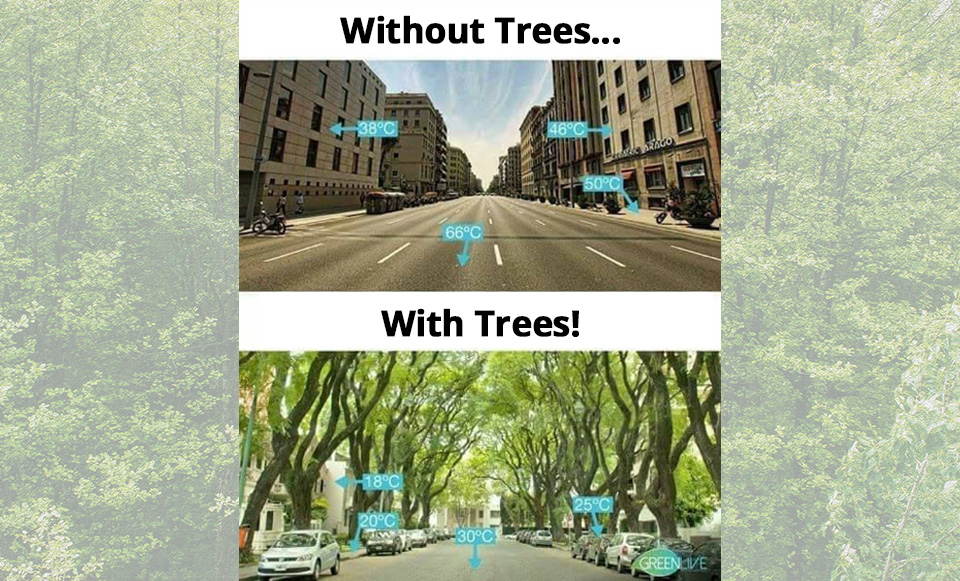
of course trees are not a substitute for air conditioning. but, on a sunny day a street heavily shaded by trees is significantly cooler than the same street with no trees. this is true no matter how hot out it is
that's not to say that the heat under a trees' shade cannot still be oppressive. merely that shade matters, as the existence of two "RealFeel" measurements you shared indicates
Going back to the beginning what started this is a debate about whether trees cool cities.
I don’t think anyone (certainly not me) has intended to argue that trees can replace AC, just that they make the city around them (including indoors in many cases) much cooler than they would be without the trees
The shade is the important effect. Air conditioners have to use energy to remove heat from the indoors. That means that if the indoors are less hot, then you need to move less energy out of the room. Trees are great here, because the trees stand in the way of our solar system's largest energy source and the indoors.
To be fair, things like insulation are also good here. You want something outside to get hot when the sun shines on it instead of whatever space you're cooling.
(There are, of course, many heat sources inside that are annoying. I was running some fuzz tests yesterday and was annoyed to watch my air conditioner scale up in power to remove the heat that was wasting. I guess that's why people use The Cloud for everything. You can heat up someone else's city while enjoying the comforts of home!)
Apparently a good part of the reason (parts of) the Midwest can get uncomfortably humid some summers despite being so far from large bodies of water is the evapotranspiration from the crops (mostly the corn). So too much evapotranspiration is not always a great thing!
With enough trees the microclimate changes enough that precipitation is more likely in that immediate area, which compounds the cooling effects on average.
I can't- the solar company I talked to said there's too much shade on my roof for too much of the day, there's no way to place the panels to make financial sense before the panels need to be replaced.
It seemed a bit odd, because my roof is fully lit up, but only for a few hours a day- one half is covered most of the morning, and the other half most of the evening.
Sadly, it's not even really nice trees, just gigantic cottonwoods that litter leaves and twigs and sticky leaf pods like crazy.
Wait a couple years and check again. With micro inverters you can deal better with partial shade. They're probably right that it makes no financial sense now, but that changes over time.
The problem with solar is that unlit panels behave like a diode and no current flows. Chain together a lit and unlit panel and you get nothing. Put the inverter ahead of the interconnects and that's not a problem.
The problem with rooftop solar in the US is that the install cost is so high. Even if the panels were free, there are many areas where you'd be looking at 15+ year payback, which is a bad investment.
I'd love to do solar, but the only way I can make the numbers work is if I DIY'd the full install.
What makes the install cost high? Where I live in Australia, 44% of houses have rooftop solar and installations seem to be done in a fraction of a day. Seems like a pretty efficient process where they bolt racks to the roofing iron and then attach panels to the racks, wire it up, etc.
Your 5-10k range installs will be $10-20,000 AFTER the tax credit, which might be a little higher now than when that graphic was put together.
Of course, this doesn't account for things like needing to re-do existing electrical work to get affected areas up to code, or if you need to replace the shingles on your roof while you're at it because it's typically recommended to do both at the same time if you're going to add solar.
Then again, you may also have the problem of ensuring your roof will withstand the extra weight, depending on the system. Most people are probably fine here, but for older houses in snowy climates it's worth thinking about as well.
I've looked into solar for my house. Aside from not getting enough sun throughout the day due to tree shade, there's also the problem that every solar calculator available wants to pretend that energy prices are going to go up 5% a year. Well, I've lived at my current house for 5 years and they haven't gone up once. The real payback for me is 20 years, if I'm lucky, even without the trees in the way.
Wow. That's quite remarkable. 7kW here was under US$4,000 including inverter, panels, installation and accounting for government rebates (some sort of credit system that the energy company handles by buying your credits off you, AFAIK). That was installed onto typical industrial metal roofing sheets - not sure of the name of it. Similar price at home installed onto corrugated iron which is very common in Australia.
Assuming you want net metering, you’d need controls in place for grid safety and such and all the permits and inspections which take time and cost money.
I imagine all that is pretty standard here also - South Australia isn't exactly without regulation or seemingly high labour costs. I used the same company at the office building and then at home, and each was painless. Approve an easy quote and then everything is later installed on a particular day. Both were in the 5-10kW range.
At the office building, the estimated payback was all of two years.
They can, but you need a suitable equipment- thicker wires, at a minimum. Wiring in parallel means the voltage is the same regardless of the number of panels, but the current sums up- so your inverter and/ or controller will need to be rated appropriately.
If you want to play that game, a sizeable part of the tree population is just going to migrate north/south.
The more immediate problem with climate change isn't that there won't be enough places to live/farm, it's that it's all going to move causing destabilization of societies.
The long term effects of running out of arable land are a considerable distance in the future.
Yes, I know but I can't make the whole list of climate change consequences for humans under each commment so I try to alert people on a part that seems relevant. Me being dark is not me trying to play a game. I have not mentioned arable land at all. If you don't see the problem of tree populations dying out I don't know what to tell you. Trees take time to grow and we need them to store carbon. But, fine, I concede to your point, we'll start killing other/get authoritarian states well before we run out of food. Somehow that does not make me feel better.
Also your framing of the question *you* are bringing up is weird. Climate change will make for climate conditions that will make agriculture *harder* in general, I don't think your model of "Oh well we'll go to cold places that have become warmer" is really relevant and by the way arable land is already a resource some states are competing for.
Maybe I'm missing something, but I don't see how we'll ever run out of arable land. The Earth has been warmer than now, in the distant past: there were times when the poles were not frozen over. Of course, this means the sea level was higher than now, so melting all the glaciers means a lot of our cities (and probably most of Florida) will be underwater, and it isn't so easy to pick up a city and move it to higher ground. A warmer Earth probably means more deserts, but there should still be arable land, in places that are currently cold tundra perhaps.
The end-end-end game is Venus-like conditions on Earth. I find that pretty unlikely though considering that population would be so reduced significantly much before that and industry would be effectively stopped. As long as any biology survives, they'd likely eventually be able to reverse the changes.
I don't see how. As I said before, the Earth has been hotter than it is now. We're currently in an ice age, and coming out of it: that's why we have ice on the poles. The Earth was never like Venus, and never will be; the thing that humans are doing now is burning a bunch of carbon that was stored in prehistoric times. Back then, it was all in plants in the biosphere, when the Earth was warmer than now.
I have mixed feelings about this. My neighbor cut down their tree, and now my living room enjoys a lot more sun throughout the day, and my yard has a lot less trash to cleanup.
My neighbor shields much of my house from the sun. We had issues when his branches started touching my roof, but we made sure it was trimmed in a way to still give us the shade it has all these years.
In the meantime my neighbor at my last house wanted me to limb up the conifer trees past my roofline so that he didn't get needles on his car.
One that wouldn't work. Two, those trees would have fallen on his house in ten to fifteen years because his house was east of the trees, and 'lions tail' tree pruning creates a giant lever arm and the roots will lose that battle in the first wind storm after a rain storm. That pattern had just played out ten years prior all over town. Big pruned Doug Firs falling onto people's houses.
What you want is to be able to be able to walk under a tree with your arms over your head and not hit branches. No more, no less.
I think an interesting way of doing this would be to have tree-like solar panels. they would be somewhat wasteful in some ways, but would organically gather solar energy at a variety of times from a variety of directions. They could also provide a % of light through in all directions to give partial shade and coexist with trees.
You will still want airconditioning in a great many cities. It gets to 45c in the forest here, no amount of trees will help the city, although of course they are still part of a good solution.
As always it's likely a combination of solutions, and rooftop solar is a good idea for more reasons than just heat.
It's a huge benefit to the crowds at street level, and keeps the city cooler overall because all that concrete is not being turned into a heated surface. They're not generally there to shade the buildings, but the people and roads.
I think of the cities in Spain with the hottest climates, and I don't see a lot of crowds being protected by tree shade: Instead, the traditional design is narrower streets which aren't straight for very long, and even white cloth hanging across the street to provide the shade directly.
It's not that there's no trees, but you'll see them in parks and boulevards that might as well be narrow parks.
If anything, I see far more trees in the American midwest. Here the streets are very wide, with basically no foot traffic to speak of, and too much road for the number of cars that use the street in urban areas. You can definitely fit trees here, but that's because so much of that concrete is waste. The extra trees just mean more distances, and more distances means more parking lots and more concrete.
I can look at the wet-bulb temperature and see exactly how far trees will get me. This time of year, it isn't far -- which checks out, because I have plenty of trees and they don't stop the heat. Swamp coolers (trees are swamp coolers, thermodynamically speaking) are brilliant if humidity is low and freshwater is plentiful, but if either of those wheels come off no amount of wishful thinking will make evaporation work comparably to a refrigeration cycle. Where I live, it's the humidity. Fortunately, I do have real AC, and even better, my power mix is predominantly nuclear so I can crank that AC and get real cooling without pumping legions of dead dinosaurs into the sky. Damn it's nice to live in the 21st century. Or the 20th.
I don't know exactly how many degrees the shade will bring the temperature down, but just today my portable temperature sensor reported an 8F degree difference compared to one in the shade - both were in the same area of the house, but one happened to be where sunlight was coming in from a narrow window. And the sensor was in the sunlight for under an hour when I recorded the difference.
Of course, this is spot heating, and over a whole house the effect will be diminished, but it tells you how quickly things can get hot.
No, I did not forget that shade exists. It's still uncomfortable in the summer. Once RH hits 100%, evaporation stops cooling and your options are to go without or to use a different thermodynamic cycle.
We've got plenty of freshwater in these parts, but in other places freshwater availability will be the limiting factor. Famously, swamp cooling works great in the desert if you can spare the water.
Trees are great, let's just be real about what they can and can't do.
No. I don't have to. The wet bulb temperature will tell you enough. No amount of trees will lower the wet bulb temperature. I live in an area with humid summers so trees help but are no solution.
A tree growing is itself an endothermic process, in addition to the passive shade and quasi-active evapotranspiration it exhibits. They will help in multiple ways, but of course only up to a point.
Considering that solar panels are close to perfectly black, they will also close to perfectly absorb the remaining 80%. The 20% of solar electricity that is then used for AC, will be released as heat as well.
You've just made a ~100% efficient heat capturing machine. The 98.1% reflecting paint will be much more efficient, with the added bonus of not being dependent on the grid.
Are PV cells really that black for photon energies below their bandgap?
It would be nice if the cells were highly reflective at a range of wavelengths between the range they can actually use and the range where they radiate waste heat.
Yes they are very black in the visible spectrum. Like the parent said a highly reflecting white paint for rooftops would certainly be the smarter choice.
They are usually reflective out of band, for unifacial (ito on semiconductor on a metallic backing), so ~40% of the radiation is heading back to space, vs 10-20% for a typical roof.
However... that means they don't radiate well at night (they have low emissivity and are not well thermally coupled to the roof). Painting the roof white is ideal.
I wasn't talking about the visible spectrum, I was talking about near IR below the bandgap (which is just below visible for Si cells.) This light does not contribute to the output of the cells, so reflecting it back into space would reduce heat generation at no loss of efficiency. If anything, by keeping the cells cooler it would slightly boost efficiency.
You can do both, typical rooftop solar installations typically don't cover the majority of the roof. Make the rest reflective and/or make it a space for people. Rooftop area has some of the greatest views in any city. Kinda crazy that we don't use it as space for humans and greenery in most cases.
I want to point out that to optimize for temperature reduction, you want to minimize absorption while maximizing thermal radiation. This says you want the surface to be reflective at wavelengths below some cutoff, but perfectly emissive (that is, black) above that wavelength. (Actually it's a bit more complex, because the atmosphere emits IR in some bands.)
Some work on surfaces of this kind have shown promising results, being able to fall below ambient temperature even in full sunlight.
Rooftops are great, we have a 100m2 rooftop terrace and kids love it. But I had no idea how hot it gets. To the point where I don’t even step outside during those heatwaves. When the offical temperature was 36C we had in fullsun above 46C and the concrete panel was too hut to wall barefoot. So my take is that in dry/hot areas rooftops are just unliveable.
Definitely depends on the area but there are flooring options that stay cool, and if really hot weather is a common issue, a misting system can keep things surprisingly cool at the cost of some water use.
I wonder, would that make for some interesting (or potentially problematic) visual side effects in an urban environment? With the variety of roof angles and sun angles, suddenly all manner of observation points (e.g. on roads) would potentially be subject to blinding reflections at different times of day and year.
These concerns already come up with things like glass and metal clad buildings - plenty of urban zoning codes already account for the light that reflects off new or modified structures (or at least try to).
It tends to be newsworthy when it goes wrong, because the results can be things like buildings cooking nearby objects at certain times of day. Spicy stuff.
Fair point. In hindsight, my mind had wandered off unsupervised, and was picturing the unadulterated chaos of an instant universal conversion of all existing rooftops to super-reflective.
"All will be simultaneously unveiled at 12 Midday tomorrow, citizens, so, ...take care out there!".
You seem to be assuming the surfaces will reflect like mirrors and not as if they are painted white. There is no reason the reflection would have to be specular.
My point was that a carbon black shingle would result in a much higher amount of work required to cool the inside of the house because you'd be baking yourself alive. The standoffs for solar prevent that. Which at 20% efficiency panels, back of the envelope says that could end up cancelling out the benefit of the panels entirely, for more than half the year.
I wondered this a long time ago too (if solar panels cause more heating by absorbing more), but actually they still reflect a fair portion of the suns energy. [This article](https://www.treehugger.com/ask-pablo-do-solar-panels-contrib...) says earths average reflection coefficient is ~0.35, and that cities are more in the range of ~0.1. Solar panels are ~0.3, so much better than many existing roof materials and of cities in general.
It can't be "doubly effective". The energy cannot simply disappear into the void. If it is used to run something electrical in the house, that energy is still there. If you ship it into the grid and across the country, less of the heating is localized. But it is still heating as it travels through the wires.
As it turns out, solar panels are often more reflective than the typical roof of a house in North America. So solar panels can actually reduce the heat island effect. But it is mostly independent of whether they are hooked up at all.
There's one other minor factor that helps even if the solar panel did nothing:
By making the sun hit at a layer above the ceiling (and assuming you have proper air circulation below), your attic area will heat less, hence your house will get less hot.
(This is similar to the effect you get by staying under a tree shadow)
As per the article, yes, if everybody had air conditioners city wide that would increase the city temperature. But that would require everyone to blast it at the same time
That street's sin is not the lack of trees, but having 6 entire lanes for cars, which apparently all go in one direction. An uncrossable nightmare that only even has stores at one side!
Those nice trees take a few decades to grow, need serious pruning, will cause foundation problems next door, and increase building setbacks anyway. We also waste two entire lanes for street parking, have basically no businesses on either side anyway, and the street is still too wide. It might be urban, but it's still a car centric hellscape, just with some shade.
That's an illusion because from certain angles the mirror is much brighter, and you don't pay as much attention to all the angles where the mirror is darker.
An ideal mirror reflects 100% of the light, and so does an ideal white surface. The white surface just spreads out the light.
If you light a mirror evenly from all angles, it will be indistinguishable from a white surface.
You can do both - having solar panels over a reflective white roof (like the fancy newly discovered passive radiative cooling paints) helps increase PV output by cooling the panel.
The solar panels will still absorb and radiate heat back so you won't get as much cooling as you would have just with passive radiative cooling paint, but it'd be better than just solar on a regular roof in both ways (solar output and thermally).
Wait what? An AC does not simply turn hot air into cold air. It "moves energy" from one place to another.
Indeed it would be nice to power the AC with solar power, but how does this help the city to cool down? You would cool down the houses, but the heat from the houses would remain in the city, it would even get hotter.
The argument is that you aren’t moving additional energy into the city from power stations to run the AC, which ends up as heat. Instead you’re using energy that’s already radiated into the city from the sky.
As others have pointed out, you might do better bouncing the incoming radiation back out of the city with white roofs. And still others say you can do a bit of both.
Also, you could definitely do well to reduce your roof albedo by switching to white/reflective roofs. This point has been made endlessly over the last 30-40 years. No one actually does it. People are actually installing solar panels.
You can also insulate roof and it'll just heat air and radiate energy in cosmos. Heating air is not a problem because it's already somewhat high and will only move higher.
> A typical solar panel absorbs ~20% of the sun's energy blasted on to a city rooftop. If that's used to power air conditioning it's doubly effective. You're reducing the heat urban heat island effect from the sun's energy, and you're also not adding additional heat from external power sources in to the city.
You’re not reducing energy here. If you gather and then release the energy again (make it do work) it’s simply being re-released.
Honestly you'd get a much more effective reduction in AC needed, for much less money, by putting a decent ceramic tint on all the glass. There are quality tints these days that have minimal effect on visible light while blocking 90%+ of IR.
I have roller shutters on my east and west facing windows, and my north facing windows (this is in Australia) get no direct sunlight because they are shaded by my patio. So no direct sunlight is coming into my house through the windows. Still in summer after ~2pm the house heats up. I think overall my house is decently insulated from the sun because in winter my house is extremely cold (what little heat the sun could give doesn't get in to my house). Recently in early spring there were days when the outside air temp was hotter than in my house.
I think reducing the absorption of the roof and the walls would help, but even then you have still have a house sitting in 34C+ air temps for at least 10 hours per day, so it gets hot. But when I consider my dads house, which has 2m eaves all around, high ceilings, and massive roof space - it still gets hot. His house might feel nicer without a/c during early summer, but by mid+late summer it is hot too.
Maybe better insulated doors+windows would help? My house is double brick walls. Maybe the "outer layer" needs to be able to get hot, and then the "inner layer" insulated from the outer as much as possible. That's a lot of change though. Instead I just run the a/c all day "for free" off my solar panels.
When you say efficient it makes me suspicious. Just because a plant doesn't absorb the energy for conversion doesn't mean it doesn't absorb it as heat. Remember, they're quite connected to the ground so they could be good heat dissipation (I have no idea, just speculating.)


A typical solar panel absorbs ~20% of the sun's energy blasted on to a city rooftop. If that's used to power air conditioning it's doubly effective. You're reducing the heat urban heat island effect from the sun's energy, and you're also not adding additional heat from external power sources in to the city.
On a large scale this would really help make cities more livable. On a hot summer day here in northern Kentucky I noticed a massive difference (I've roughly measured it at a 5-7F difference) going from less developed areas to the more urban areas.